1.5 tonnes an hour.
Sorted and logged.

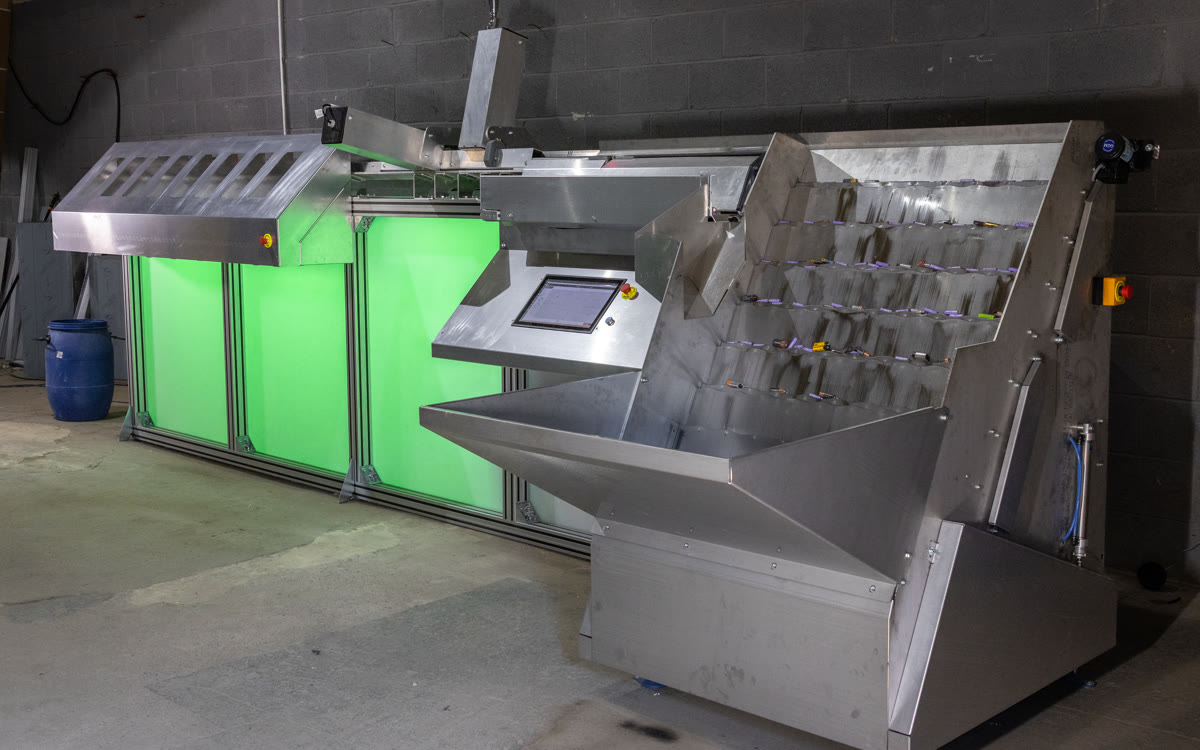
Mixed batteries in, clean chemistry out, at up to 1,500 kg an hour. Every cell is photographed and logged as it goes. Built in Britain, running now.

Scroll
1,500kg/hr
Per hour, OBS-2
28/sec
Cells a second, OBS-2
100%
Logged for audit
1
Operator
0air
No compressed air. A three-phase supply and a floor is the whole utility requirement.
01
01 / Feed
Tip them in
as they come.

Mixed batteries go in loose and the feeder does the rest. No bridging, no manual spreading.

02
02 / Singulation
One cell,
one lane.

The deck spreads the pile into single file so nothing overlaps and every cell gets seen on its own.

03
03 / Optical ID
The camera reads
every one.

Chemistry, size and brand, identified as each cell goes past. It all lands in the log as it happens.

04
04 / Electric sort
No air,
no compressor.

A timed electric actuator drives each cell into its own stream. Alkaline, zinc-carbon, Li-ion, NiMH, NiCd, 28 a second.

05
05 / Output
Clean fractions,
on their way out.

Each chemistry leaves in its own stream, checked before it goes. One person runs the line.

01
Feed & singulation
Bulk mixed cells,
climbed out single file.
Batteries tip in loose. The step feeder lifts them out of the hopper and lays every cell into its own lane. No bridging, no manual spreading.
Nothing gets guessed

Two ways it
double-checks itself.

Recovery loop 01

Piggyback return

Cells sitting on top of each other get pulled out and shown to the camera again.

Recovery loop 02

Re-classification loop

Anything it isn't sure about goes round again rather than spoiling a clean batch.
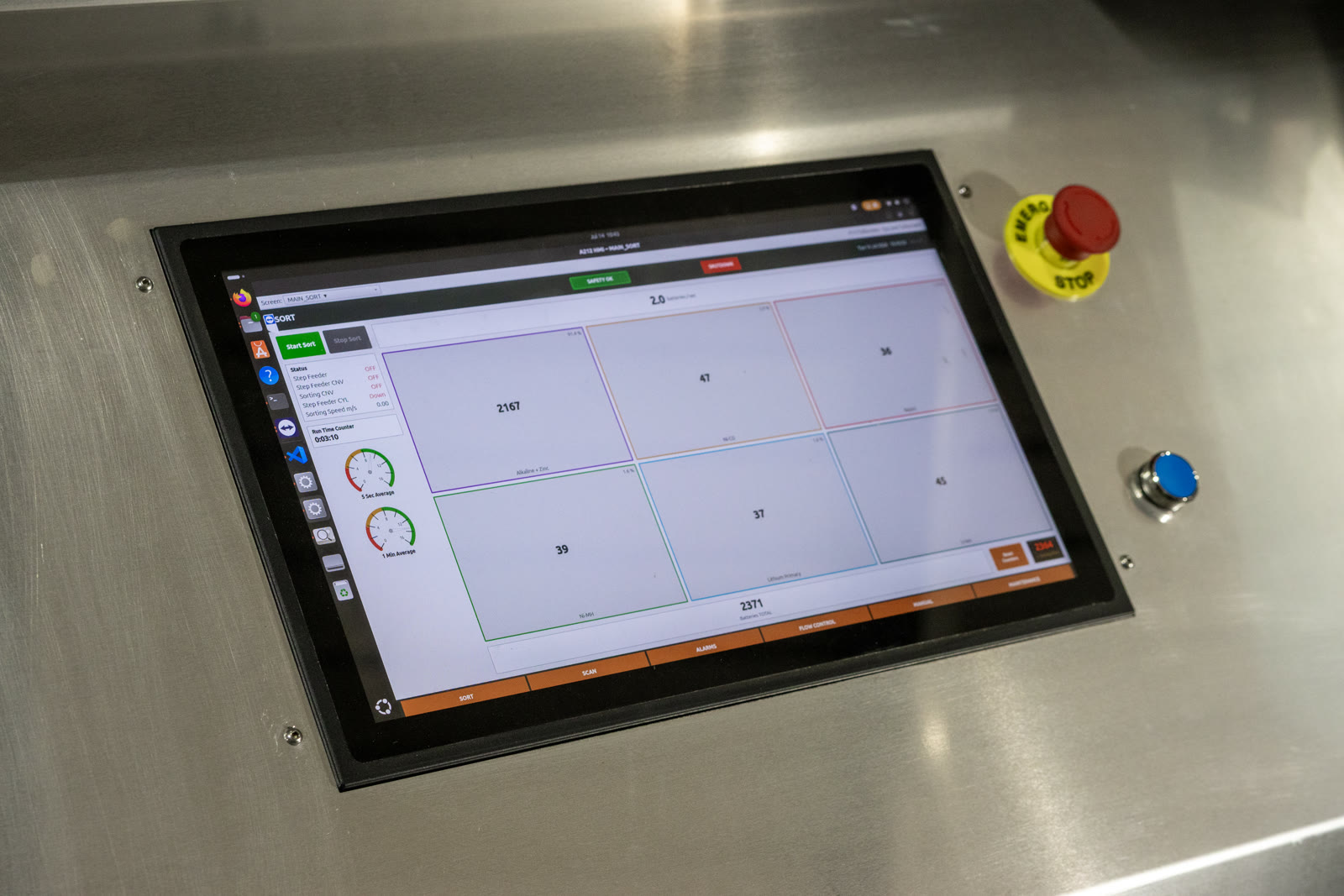
OBS control screen showing live per-chemistry sort counts
EU Regulation 2023/1542

The paperwork writes
itself.

EU 2023/1542 wants chemistry-specific proof. Every cell is photographed and logged as it runs, so the evidence is already there when you need it.

SizeBrandChemistryPer batchPer customerFull cell log
Collection target · end 202763%
Collection target · end 203073%
OBS cells logged, always100%
The OBS range

Two sizes.
Same machine.

Identical vision system and software. Start smaller and add capacity later, on site.
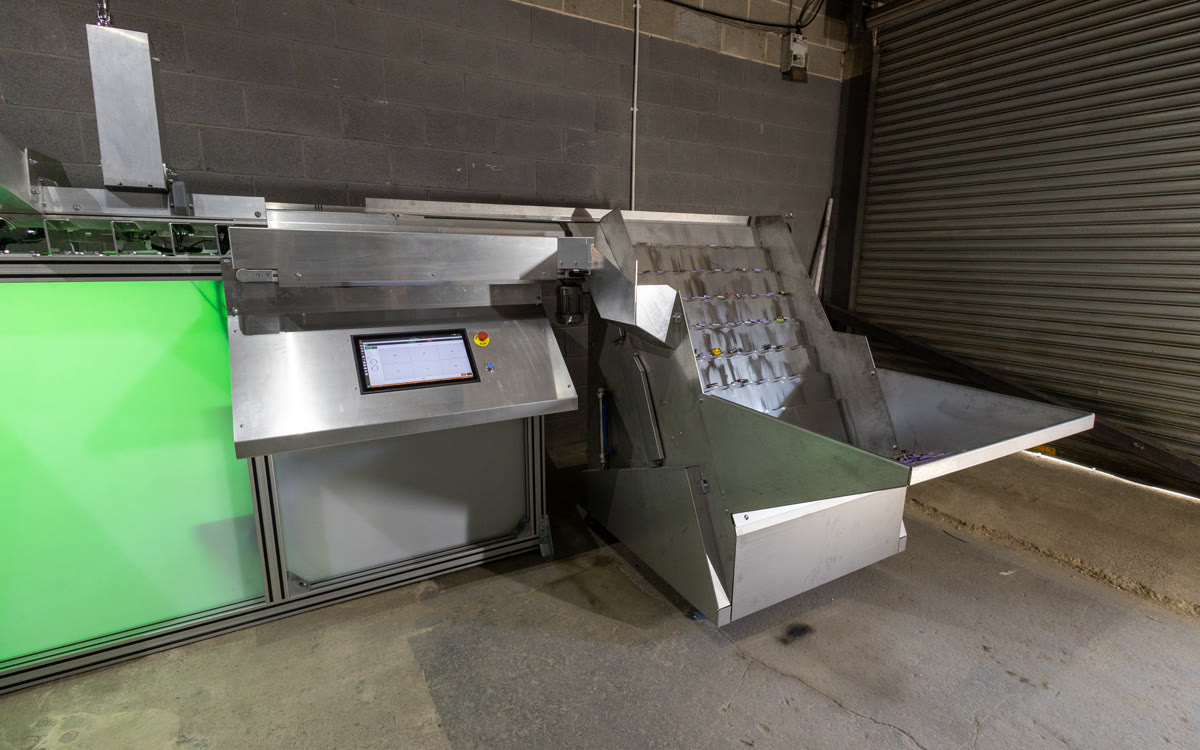
OBS-2 dual-lane optical battery sorter
OBS-2 Flagship

~1,500

kg/hr indicative
Feed lanesDual step feeder
Sort rate28 cells / second
Net weight1,650 kg
Power9 kW
Compressed airNone required
Main cell6.1 × 4.1 × 2.1 m
ControlIndustrial PC · 2a2i software
OBS-1 single-lane optical battery sorter
OBS-1

~750

kg/hr indicative
Feed lanesSingle step feeder
Sort rate14 cells / second
Net weight875 kg
Power5 kW
Compressed airNone required
Main cell6.1 × 2.1 × 2.1 m
ControlIndustrial PC · 2a2i software

Throughput depends on your battery mix. We size it against your material.

Capacity calculator

Size your plant
in one question.

Size your plant in one question. Tell us your annual tonnage and we will show you the configuration, the floor space, the power and what it does to your sorting headcount. Then generate a proposal.

Privacy notice: we use the details you submit to respond to your enquiry.

Prepared for
One question. No commercial detail needed.
Sizing Your Plantindicative
tonnes / year
100 t2,500 t5,000 t10,000 t
people  leave blank if you are not sure
Your detailsso we can address the proposal to you
Privacy notice: your details are used to respond to this enquiry and prepare the proposal.
Machine performance
The labour figure is a regional starting point only. Put your own loaded cost per hour in, including on-costs, and every money figure on the right follows it.
1.  Select Your Machine
Full machine specification
Fixed specification: optical spectral imaging, no radiation and no shielding required. Classification accuracy target 98% on primary chemistries and 96 to 97% on minor chemistries, with a 4 to 6% reject rate. 380 to 415 V, 3 phase, 50 or 60 Hz. All-electric ejection, so no compressed air supply, compressor, dryer or receiver is required. Operating range 5 to 40°C. Remote diagnostics included. A pre-sort stage ahead of the OBS is required to remove alien objects, button cells and heavily contaminated material.
2.  Your Feedstock Mix by Sizeedit to match your own gate sampling
Size bandShare % by countAvg mass (g)Share by mass
Total100.0weighted avg (g)
The OBS sorts on size and appearance, so the mix that matters is the size band, not the chemistry. Shares are by cell count, not weight. If they do not total 100% the model normalises them and flags it. The starting split is a typical mixed household collection. Replace it with your own gate sampling for a firmer answer.
3.  Your Volumes and Operating Pattern
Conservative factor covers feed consistency and cells recirculated for a second classification pass. OEE covers planned maintenance and unplanned downtime. The defaults are deliberately cautious. Pre-sort losses cover damaged cells, button cells, alien objects and heavily contaminated material set aside for manual handling.
4.  Your Costs and Revenueall values in the selected currency
Enter your own gate fee, avoided disposal cost or downstream value per tonne. Leave any figure at zero if you cannot stand behind it, the capacity and sizing results do not depend on it.
Results
Your Result
Recommended configuration
Sorting staff this replaces
Labour cost avoided each year
Payback on labour alone
Results
Effective sorting rate
kg/hour
Units required for your volume
Annual capacity, one machine
Tonnes processed per year
Hours · shift pattern ·
Recommended
Alternative
Floor area · connected load ·
Capacity headroom
Labour
Electricity
SaaS licence
Service & spares
Consumables
Misclassification
Total annual opex
Operating cost per tonne
Against manual sorting
Manual headcount for same volume
OBS operators
Headcount displaced
Annual labour avoided
Gate fee revenue
Sorted-fraction uplift
Less annual opex
Net annual cash flow
Simple payback
Total investment (net of grant)
10-year net position
Return on investment (10 yr)
Cumulative net cash position, years 0 to 10.

Want this in writing?

Generate a proposal against the figures on this page: configuration, throughput, footprint and terms, ready to print or forward.

Get your proposal Email us
Setup  |  2a2i Ltd  |  OBS Capacity & Payback Calculator  |  Indicative planning tool, not an offer  |  2A2I-CAL-OBS-02 Rv3.5

Throughput and capacity figures are indicative and depend on feedstock mix, cell condition and feed consistency. Classification accuracy is stated as a target until proven at industrial scale on customer feedstock. No currency conversion is applied. This tool is a planning aid, not a performance warranty, a quotation or an offer to contract.
2a2i setup locked

Enter the setup password to load pricing, licence rates and branding.

Branding
Lead capture
Proposal
Machine performance
Machine, per unit
Site, one off
Recurring
Machine prices are for the OBS unit only. Conveyors, integration, freight, installation, the pre-sort stage and site works are quoted separately against your layout. SaaS is billed monthly per machine and shown here annualised. Nothing in this tool constitutes an offer or a price.
Access

A customer copy opens locked with the setup panel hidden. A working copy opens unlocked for you. Both carry the pricing, branding and figures currently on screen.

Config
Replaces
Payback
Next step

See it run on
your batteries.

Twenty minutes on video. We run the machine, you ask whatever you want. Nothing to prepare.

Or email us directly at info@2a2i.co.uk

About 2a2i

Battery sorting,
proven in production.

50M+ batteries processed and classified by the original production system
98% classification accuracy target on primary chemistries, proven against customer feedstock
0 air all-electric ejection with no compressor or compressed-air utility requirement
1 operator OBS-1 or OBS-2 runs with one operator and a three-phase supply

We build machines that sort waste batteries by chemistry, cleanly and at scale. Mixed cells go in. Sorted, clean chemistry streams come out, at rates up to an indicative 1,500 kg an hour. Every cell is photographed, classified and logged as it passes through.

The Optical Battery Sorter (OBS) is not a prototype. The original system ran in production for over two years and processed and classified more than 50 million batteries in that time. What we have now is a generational step change on that proven base: the same core approach, rebuilt with everything two years of real running taught us.

OBS uses optical spectral imaging to identify each cell. There is no radiation, no shielding and no licensing to manage. Classification accuracy targets 98% on the primary chemistries, and we hold to those as targets until they are proven on customer feedstock at industrial scale.

The machine is built in Britain and running now. It comes as OBS-1, a single sorting line, or OBS-2, two parallel lines on one platform, with a single unit field-upgradeable to a dual on site. Whichever the size, it runs on one operator and a three phase supply. Our latest generation uses all-electric ejection, so there is no compressed air, no compressor and none of the power draw and maintenance that come with it. That is a saving for the customer and a genuine point of difference against the older air-jet machines.

We are a small engineering company that would rather prove a number than market one. If you have a battery waste stream to sort, we would welcome the chance to show you the machine at work.

Contact

Talk to 2a2i
about OBS.

Send a short enquiry and the team will come back to you with the next step.

2a2i contact details

Email: info@2a2i.co.uk

Location: United Kingdom

Privacy notice: we use your details to respond to your enquiry.